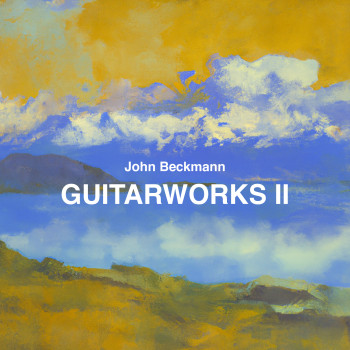
The Mortal Prophets- John Beckmann’s ever-evolving experimental vessel- step away from the decadent surrealism of French Summer and into something far more elemental with ‘GUITARWORKS II’. Where that earlier release swirled with European glamour and sly provocation, this 16-track collection is stripped to its bones, letting the spaces between notes breathe like ancient air. It is, in every sense, a meditation- on time, place, memory, and the invisible threads that bind them.
Each piece arrives like a postcard from another age, yet speaking in a language of sustained guitar tones, weathered analogue textures, and the slow erosion of sound. The music feels less composed than unearthed, as if Beckmann had brushed away the dust to reveal melodies already etched into the earth. His touch is restrained but deliberate, letting loops and harmonics decay at their own pace, like sunlight fading over stone.
There’s an American transcendentalist spirit at work here- Thoreau’s stillness, Emerson’s reverence- yet ‘GUITARWORKS II’ is equally rooted in the ambient traditions of Robert Fripp, Stars of the Lid, and Brian Eno’s spectral collaborations with Cluster. Beckmann has clearly absorbed these influences, but instead of imitation, he distills them into something uniquely topographical. This is ambient music as cartography, mapping sacred geography through sound.
Unlike its predecessor, there are no cinematic blues flourishes or vocal apparitions here- only instrumental vignettes, each under four minutes, that act as self-contained rituals. They work best in sequence, a drift through ghostly corridors of reverb and tape warmth, where imperfections become part of the architecture. You don’t so much listen to ‘GUITARWORKS II’ as inhabit it- headphones on, twilight settling, the outside world dissolving.
This is an album for the hours when the day exhales, when you can hear your own pulse against the hum of the horizon. A slow-burning act of preservation, it keeps alive the idea that some landscapes- sonic or otherwise- are sacred simply because they endure.