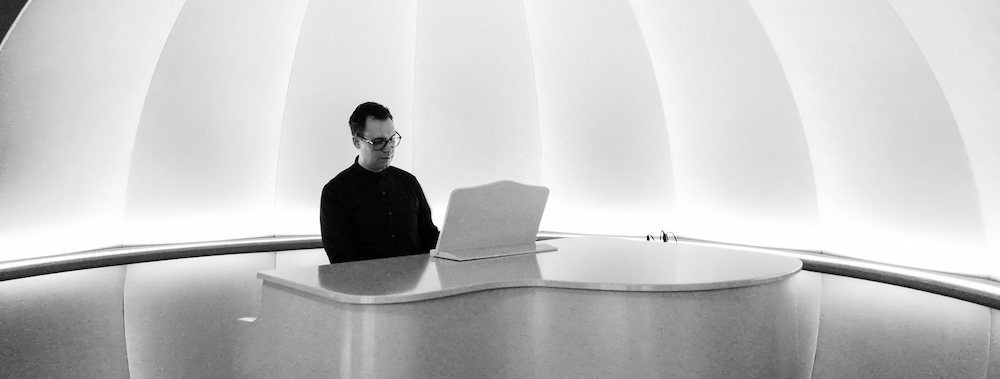
Fierce Friend’s ‘Tokyo Rose’ begins in familiar territory and then slowly dismantles it.
At first, the Brighton artist’s third single from forthcoming album Blood Red Hills & The Uncanny Valley feels almost restrained: sparse piano, intimate vocals and a sense of quiet uncertainty. But Alan Grice has little interest in keeping the song there as repeating motifs begin to overlap, rhythms shift against one another, and the arrangement gradually expands until that opening stillness has been replaced by something dense, hypnotic and increasingly unstable.
Inspired by the disappearance of Amelia Earhart in 1937, ‘Tokyo Rose’ focuses on the mystery surrounding that infamous headline: honing in on the searchlights, static, rumours, phantom transmissions and decades of speculation that have blurred the line between history and mythology.
Piano patterns accumulate in a way that recalls Steve Reich, while the melodic intimacy has something closer to Ben Folds or Sufjan Stevens. As drums, guitar, cello and harp begin to enter, the song becomes more fractured, eventually tipping into an electronic four-to-the-floor pulse that feels almost like the floor is shifting underneath you.
But what makes ‘Tokyo Rose’ work is that the experimental elements aren’t simply there for decoration. The polyrhythms, loops and competing textures all reinforce the idea of signals interfering with one another and meaning becoming harder to locate the closer you listen.
It makes the track a striking contrast to previous singles ‘Blood Red Hills’ and ‘Put You Right’, revealing a more exploratory side of Fierce Friend’s forthcoming record.
By the closing moments, ‘Tokyo Rose’ feels suspended somewhere between ocean floor, radio frequency and fever dream. It’s eerie, inventive and deliberately unresolved; delivering a fitting musical response to a story that has resisted certainty for nearly ninety years.