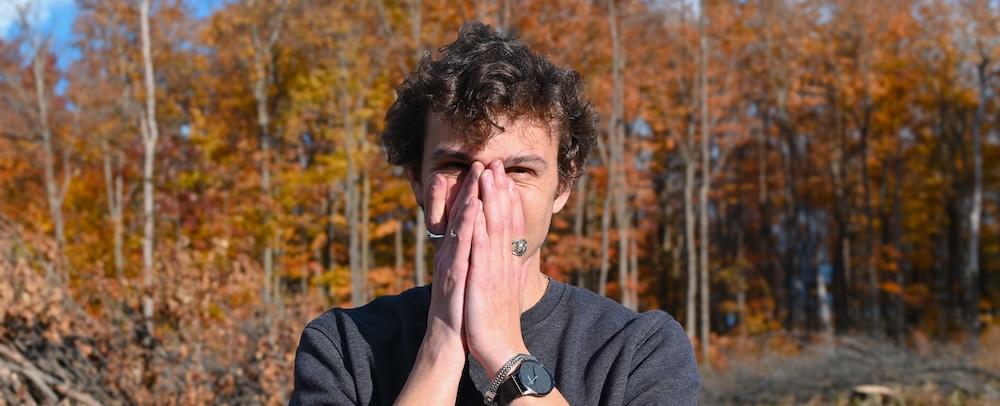
There’s something quite powerful about an artist choosing not to tidy up the difficult parts of life, and on his new release A Nice Neighborhood to Have Bad Habits In, Ryan Yingst leans fully into that instinct. The Philadelphia-based indie-folk singer-songwriter turns addiction, grief, family fracture and personal upheaval into an EP that feels reflective without ever becoming self-pitying.
Throughout, the frontman is clearly writing from places of real pain, but it never feels judgemental. Instead, these songs sit with their subjects long enough to find something pure and human inside them.
‘The Tallest Trees’ is perhaps the clearest example of this approach. Written around stories of people who lost partners during the pandemic, the song expands into a broader meditation on mortality and what happens when grief becomes too heavy to carry. Recorded partly live with guitar, vocals, drums and cello, it has an immediacy that suits the material, while later overdubs add depth without disturbing that emotional centre.
While its closer ‘We Were Once Wild’ hits differently. Beginning with the fallout of his parents’ divorce, the song grew over several years before eventually finding its final shape. Rich acoustic guitar and carefully arranged strings give it a sweeping, nostalgic quality, capturing the strange ache of looking back at something that can never exist in quite the same form again.
Elsewhere, ‘Dopamine’ approaches addiction from a more unusual perspective, imagining the substance itself as part of the conversation, while ‘If I Don’t Have You’ brings in more of his rock instincts and provides a looser, more playful counterweight to the heavier material.
His influences here stretch from Shakey Graves and Gregory Alan Isakov to Oasis, The Cure and Jeff Buckley, but the EP often feels strongest when those different worlds overlap.
With A Nice Neighborhood to Have Bad Habits In, Ryan Yingst has created a thoughtful and emotionally generous collection. It doesn’t romanticise pain, but it does recognise that difficult experiences often leave behind something worth understanding. Warm, bruised and deeply intimate, it’s the sound of a songwriter finding beauty in what refuses to resolve neatly.